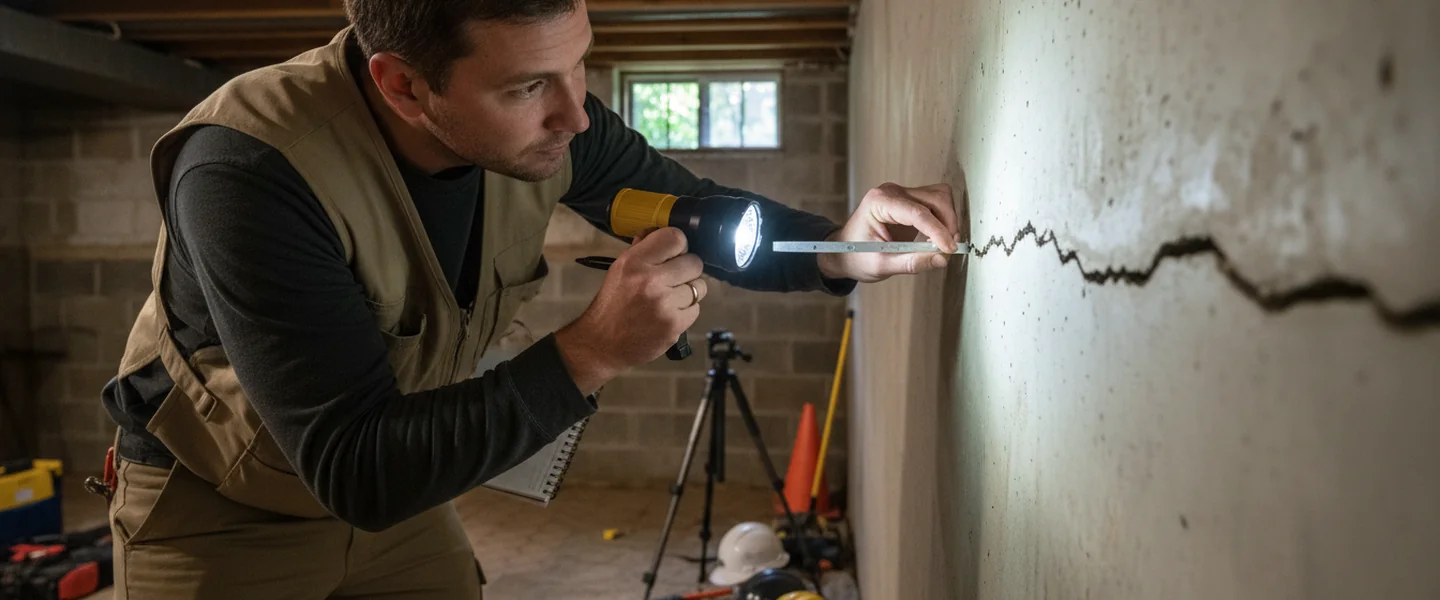
Richmond houses settle. Not all of them, and not equally, but enough that it shows up in casual conversations across Henrico, Chesterfield, and the West End suburbs. Some of that settlement is the normal background process of expansive red clay swelling and shrinking through 50 years of seasons. Some of it is differential — meaning one corner of the home is dropping faster than the other — and that is what is actually fixable. This guide explains the geology, the patterns, and what a homeowner can do about it.
The Geology Under Your House
The Richmond metro sits on a transitional band where the Piedmont (the rolling-hill region west of the city) meets the Coastal Plain (the flatter, sandier region east toward Williamsburg and Tidewater). That transition produces a specific soil profile: a layer of expansive red clay 4-12 feet thick, sitting on top of sandier subsoil, sitting on top of competent bearing strata at depths varying from 12 to 30+ feet.
The expansive clay is what drives most Richmond foundation movement. When it rains heavily and the clay saturates, it swells. When summer drought dries it out, it shrinks. That seasonal swell-shrink cycle is mechanical movement — pressure against your foundation walls during wet seasons, settlement during dry seasons. Multiplied over 30-50 years, it walks foundations sideways and produces the cracks Richmond homeowners are familiar with.
Why Some Houses Settle and Others Don’t
Four factors determine whether your specific house will show settlement issues:
1. The age of the foundation
Pre-1970s construction in Richmond often used CMU block walls with no horizontal rebar reinforcement and shallower footings. Modern code (post-1980s) requires reinforced poured concrete with deeper footings — those handle expansive clay much better.
2. The lot grading
Lots that slope toward the foundation hold water against the wall during every rain event. Lots that slope away from the foundation drain naturally and stay drier. The single highest-impact maintenance task on most Richmond homes is restoring the 6-12 inches of fall away from the foundation in the first 10 feet.
3. Tree proximity
Mature trees within 20-30 feet of the foundation pull water from the clay during summer, causing differential drying and settlement on that side. The classic pattern: settlement at the corner closest to the oak tree.
4. Gutter and downspout function
A downspout that discharges at the foundation for 10 years saturates that one spot constantly, swelling the clay during wet years and producing differential settlement during dry ones. The fix is downspout extensions — at least 10 feet from the foundation.
The Signs of Settlement (Visible from Inside the House)
- Sticking interior doors at one corner of the house — typically the corner that is settling
- Diagonal cracks above interior doorways — drywall cracks that follow the stress direction of the settled corner
- Stair-step cracks in brick veneer — diagonal cracks following the mortar joints, almost always indicating differential settlement
- Sloping or sagging hardwood floors — measurable with a marble or a 4-foot level laid on the floor
- Gaps between trim and walls or ceilings — caulk lines that have opened, baseboards that have separated from the wall
- Window or door frames out of square — visible diamond shape when you look at the frame against the wall
What’s Fixable — and What Isn’t
Fixable
Differential settlement at exterior corners — fixable with push piers or helical piers driven through the active soil zone to competent bearing strata. The home is mechanically jacked back toward level (typically within 1″ of original elevation) and the load is transferred permanently to the deeper soil.
Settlement-related cracks — fixable with epoxy injection plus carbon-fiber reinforcement after piering has stopped the underlying movement.
Saturated-soil-related issues — fixable by improving exterior drainage (downspout extensions, grade restoration, French drain installation if necessary) so the clay does not cycle as severely.
Not fixable
The clay itself. You cannot change the soil under your house. The repair strategy is to bypass the active soil zone (piering) and manage the water that drives the swell-shrink cycle (drainage).
Some pre-existing damage. Hardwood floors that have warped from years of moisture and movement do not unwarp when you level the foundation. Drywall that has cracked needs to be re-taped and repainted. Brick that has spalled needs to be replaced. These are foreseeable side effects of foundation work, not failures of the repair.
The Diagnostic Process
A proper Richmond settlement diagnostic includes:
- Elevation survey with a Ziplevel manometer in every room — produces a topographic map of the floor
- Exterior perimeter walk documenting brick or siding cracks, gutter discharge, grading, and tree proximity
- Crack measurement with feeler gauges and crack monitors on any active crack
- Soil discussion with the homeowner — when was the lot last regraded, where do gutters discharge, are there mature trees within 30 feet
- Written report categorizing observed conditions and recommending scope
Bottom Line
Most Richmond settlement is gradual, locally driven by clay-and-water, and partially fixable. Differential settlement at exterior corners is the most common pattern and is addressable with push piers and drainage improvement. The diagnostic should be honest about what is fixable structurally versus what is fixable with maintenance (gutter extensions, grade restoration) versus what is not fixable at all (the soil itself). Call (804) 885-2258 for a free elevation survey and written report.
Questions to Ask About Any Settlement Diagnostic
- What is the differential elevation, in inches, between the highest and lowest corners?
- What is the soil condition under each corner, in your professional judgment?
- Is the cause primarily settlement, primarily drainage, or both?
- If we install piers, how much lift can we expect — and at what risk of cosmetic finish-work cracking?
- What maintenance changes (gutter extensions, grading, tree removal) would reduce the risk of recurrence elsewhere?
- Is engineering documentation included, and at what cost?
What Not to Do
Three patterns we see Richmond homeowners regret:
Ignoring early settlement signs for 10+ years. A 1/2″ differential that is caught early can usually be addressed with 4-6 piers. The same differential left to grow to 2″+ may require 12+ piers and significant finish work.
Accepting a “complete underpinning” quote without an elevation survey. If the diagnostic was not done with measurement, the scope is a guess.
Skipping drainage improvement after piering. If you do not fix the gutter discharge that caused the settlement in the first place, you will eventually have settlement at a different corner.
Richmond-Specific Considerations
The expansive clay across central Virginia is well-documented in geological surveys, and any local foundation contractor should know which corridors are most affected. Glen Allen and Short Pump subdivisions built into cut-and-fill lots are particularly common settlement candidates — the fill side typically settles faster than the cut side, producing differential. Henrico and Chesterfield ranches and split-levels built in the 1960s-1980s with shallow footings are another consistent pattern. Modern construction on engineered foundations is much more stable.
Common Misconceptions About House Settlement
“All houses settle equally”
False. Uniform settlement is rare; differential settlement is what causes the visible damage.
“Houses settle for the first 5 years and then stop”
Sometimes. Houses on stable, well-drained soil do settle within a few years and stabilize. Houses on expansive clay continue to cycle seasonally for the life of the structure.
“If I level the floors, the cracks will close”
Mostly — but not always perfectly. Drywall and finish work that has cracked typically needs to be re-taped and painted regardless of how well the foundation is leveled.
“Piering will damage my plumbing or HVAC”
Done correctly, no. A reputable contractor will locate utilities before excavation and avoid them. Done sloppily, yes — which is why crew experience and engineering documentation matter.
Get a Free Written Foundation Quote in 24 Hours
Same-week appointments. No high-pressure sales. Every quote itemized in writing after a 30-minute on-site inspection.