Foundation problems rarely arrive overnight. The serious cases we see in the Richmond metro are almost always 5-10 years of accumulated small signals that the homeowner noticed but did not act on. This guide is the list of early signs — the ones that look minor when you first see them and that get expensive to fix when ignored. Catching these in year one or two is what keeps a small crack injection from turning into a multi-pier underpinning.
The Early Signs — What You Can See Yourself
1. Sticking interior doors at one corner of the house
When a single corner of your home settles, the door frame in that area shifts out of square. The result: doors that used to swing freely now stick at the top or bottom. The classic pattern: bedroom door near the affected corner sticks first, then progressively more doors as settlement continues.
2. Diagonal cracks above interior doorways
Drywall cracks that follow the diagonal from the top of a door frame to the corner of the wall or ceiling. These reflect stress concentration at the door opening as the wall above shifts. A single crack is monitoring territory; multiple cracks at multiple doorways is a foundation diagnostic.
3. Stair-step cracks in brick veneer
Cracks that follow the mortar joints diagonally up the exterior brick. These are almost always differential settlement signals — they are not normal weathering, they are not “the house settling in,” and they get wider over time without intervention.
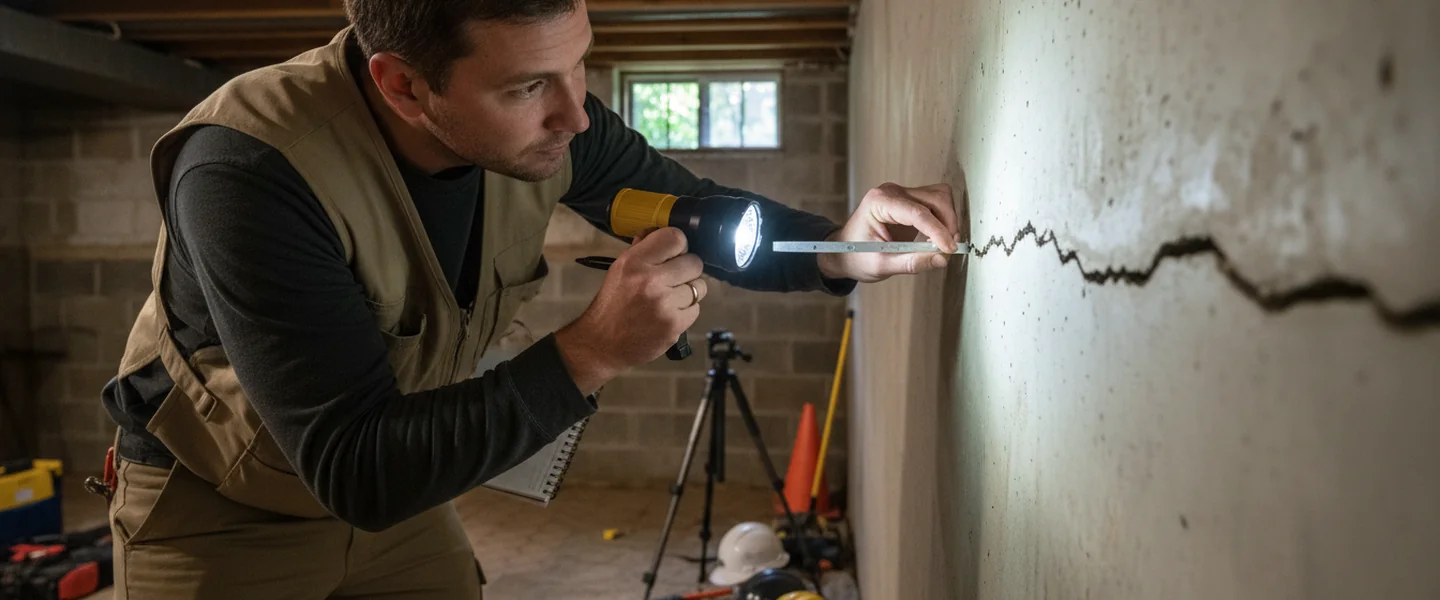
4. Hairline cracks in basement walls
A single vertical hairline in a poured concrete basement wall is often shrinkage and benign. Multiple hairlines along the same wall, particularly along the back wall on the high side of a graded lot, often indicate developing hydrostatic pressure problems. Inject early and the repair is cheap; wait and the wall bows.
5. Water staining or efflorescence on basement walls
White crystalline deposits (“efflorescence”) on basement block or poured walls indicate that water has been moving through the wall, evaporating, and leaving mineral deposits behind. This is a basement waterproofing call — the water is already coming in, you just are not seeing standing water yet.
6. Sloping or sagging hardwood floors
Lay a marble on the floor at the center of each room and watch where it rolls. Even 1/4 inch of slope over 10 feet is a measurable differential. Two or more rooms sloping toward the same corner is the diagnostic pattern.
7. Gaps between trim and walls or ceilings
Caulk lines that have opened over the past few years, baseboards that have separated from the drywall, crown moulding that no longer meets the ceiling — these all reflect wall movement. When the gaps appear at a single corner of the home, settlement is the likely cause.
8. Window or door frames out of square
Look at the frame against the surrounding wall. A subtle diamond shape — top of the frame leaning one way, bottom the other — means the wall around the frame has shifted. This often precedes operational issues (sticking, gaps at the weatherstripping).
9. Chimney separation from the house
Vertical cracks between the chimney and the adjoining wall, or a chimney that visibly leans away from the house. Chimneys frequently settle at a different rate than the house because they are on their own footing — these are foundation diagnostics, not chimney maintenance.
10. Pooling water at the foundation
If water stands within 5 feet of the foundation after a normal rain, the grading is not moving water away. Standing water saturates the surrounding clay, accelerates swell-shrink cycling, and over years produces the settlement and bowing problems above.
What to Do When You See One of These Signs
The action is sequenced by severity. Most homeowners can self-monitor for 90 days before calling a contractor:
- Document the sign. Photograph it, measure it if possible, mark it (pencil mark at the ends of a crack), and date the photograph.
- Check for related signs. A single sticking door means little; a sticking door + a diagonal drywall crack + a window out of square in the same corner is a pattern.
- Re-check in 90 days. Has it grown? Has it stayed the same? Growth = active; static = monitoring territory.
- Call for inspection if you see growth or pattern. A 30-minute free on-site inspection with a written report tells you whether you are looking at maintenance or repair.
Why Catching These Early Saves Money
Foundation repair costs scale non-linearly with severity. The repair math:
- A 1/16″ crack identified and injected: low-cost polyurethane injection
- The same crack ignored for 5 years, now 1/4″ wide with displacement: structural crack repair with carbon fiber + injection
- The same crack ignored for 10 years, now part of a bowed wall: bowing wall stabilization with anchors + injection
- The same condition ignored for 15+ years, now with measurable corner settlement: piering + waterproofing + bowing wall repair + crack repair
Each step up in scope can be 3-5x the cost of the prior step. Catching the original 1/16″ crack costs a fraction of what the full-system repair costs at year 15.
Bottom Line
The most expensive foundation repair is the one that started as a cheap crack injection 10 years ago and was ignored. Look for the 10 signs above. Document and re-check at 90 days. Call for inspection when you see pattern or growth. (804) 885-2258 — free on-site inspection, written report within 24 hours.
Questions to Ask the Inspecting Contractor
- Which of the signs I see are actively progressing versus stable?
- What is the underlying cause — soil, water, settlement, or all three?
- What repair scope is required now versus what can be monitored?
- What maintenance changes would slow progression at conditions that are not yet repair-eligible?
- If I do nothing for another 5 years, what is the realistic next-stage condition?
What Not to Do
Three responses we see Richmond homeowners regret:
Painting or caulking over the visible symptom. Surface repair hides the visual but does not address the cause. The next heavy rain or seasonal cycle re-cracks the patch.
Comparing yourself to neighbors. “My neighbor’s house has cracks too” is not a diagnostic. Their cracks might be cosmetic; yours might not.
Waiting until you intend to sell. Selling with active, undisclosed foundation issues creates either disclosure litigation exposure or significant price concessions at inspection. The repair costs less than the discount you will take at sale.
Richmond-Specific Considerations
The expansive red clay across central Virginia produces a specific early-warning pattern. The first sign to appear, in most cases, is water staining on the back basement wall on the high side of a graded lot — typically the wall facing the highest soil pressure during heavy rain events. The second sign, usually 1-3 years later, is a hairline crack or small bow developing in the same wall. The third sign is differential settlement at the corner that has been receiving the gutter discharge that was never extended. Knowing the sequence is what lets a local contractor diagnose and quote accurately at the first inspection.
Common Misconceptions About Early Signs
“All houses get cracks; mine is fine”
Cosmetic cracks are normal; growing or patterned cracks are not. The diagnostic distinction is what you need from the inspection.
“I will know when it is serious”
Often false. By the time the symptoms are obvious enough to be unmistakable, the repair scope has typically tripled.
“A small crack will not affect my home’s value”
Documented and repaired cracks do not affect value. Undocumented, untreated cracks discovered at sale-time inspection consistently produce price concessions of 2-5% of sale price.
“DIY filler will handle most of these signs”
Cosmetic filler hides; it does not repair. For any sign that is growing or part of a pattern, a written diagnostic is the right next step.
Get a Free Written Foundation Quote in 24 Hours
Same-week appointments. No high-pressure sales. Every quote itemized in writing after a 30-minute on-site inspection.