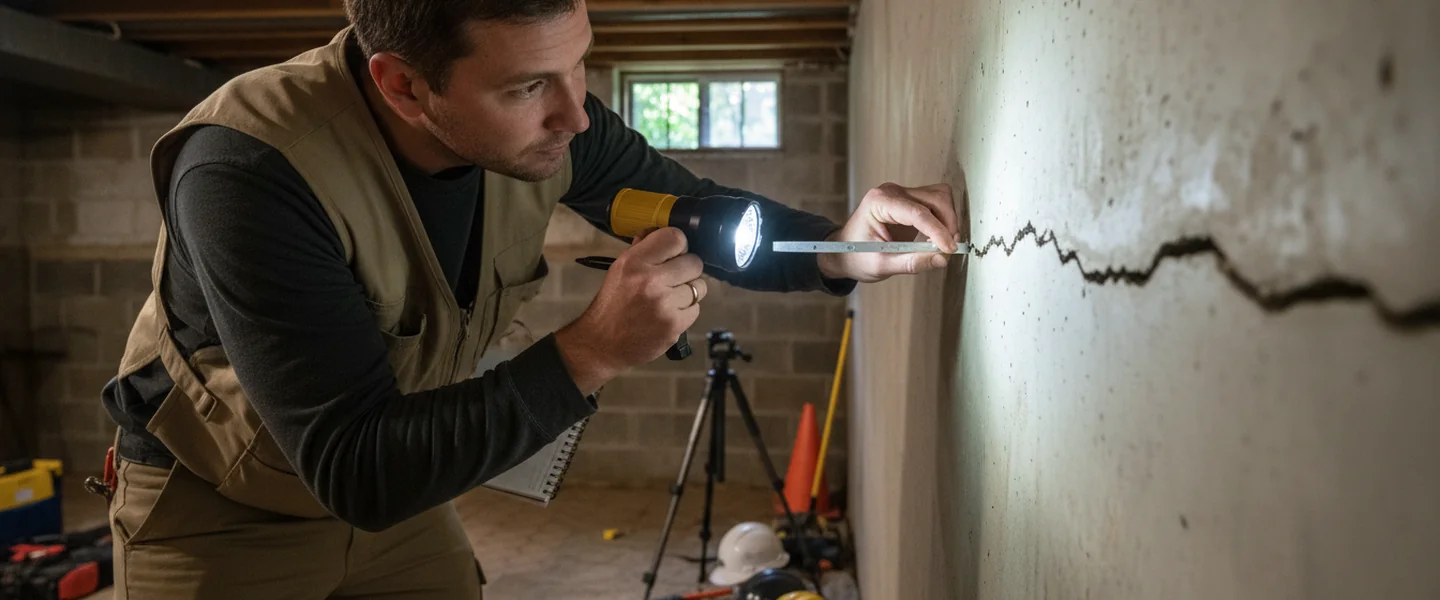
“Does homeowners insurance cover foundation repair?” is one of the first questions Richmond homeowners ask when they see a serious crack or a wet basement. The answer is almost always: no, not directly — but the full story has exceptions worth understanding. This guide walks through what a standard Virginia policy covers, where the exclusions sit, and how to talk to your adjuster productively.
Why Standard Policies Exclude Foundation Movement
Standard HO-3 homeowners policies in Virginia exclude damage from earth movement, settling, and gradual water damage. Those exclusions are not unique to Virginia — they exist in standard policies nationwide because foundation movement is considered a maintenance issue, not a covered peril. Insurance is designed to cover sudden, accidental losses, not predictable gradual deterioration.
The practical result: a foundation crack that opened over 30 years of expansive-clay cycling is not covered. A bowing basement wall that has been moving slowly for a decade is not covered. A wet basement that floods every spring is not covered.
The Exceptions Where Coverage Might Apply
1. Burst plumbing under or above the foundation
If a water supply line bursts under your slab or above the foundation and the resulting water damage causes foundation movement, the burst-pipe damage is typically covered. The foundation repair itself may or may not be covered depending on policy language — but the related water damage almost always is.
2. Sudden sinkhole or earth movement
Some policies include sinkhole coverage as a separately-rated endorsement. Standard policies typically exclude it; specifically endorsed policies cover it. Read your declarations page to find out.
3. Covered-peril events that triggered the movement
A tree falling on the home, vehicle impact, or other named-peril damage that caused foundation movement may be covered under the perils that triggered it. The connection has to be documented — sudden, identifiable cause.
4. Storm-driven structural damage
Tornado or severe-wind damage to the foundation is rare but covered when it occurs. Hurricane-driven damage in Virginia is rare west of Hampton Roads but possible.
How to Talk to Your Adjuster
If you believe your foundation issue traces back to a covered peril, the process is:
- Document the trigger event with photographs, dates, and supporting records (police report for vehicle impact, plumber’s invoice for burst pipe, weather data for storm event).
- Get a written contractor diagnostic that traces the foundation damage causally back to the trigger event. This is where having an experienced local contractor matters — the written report is the document your adjuster will review.
- File the claim within policy timeframes. Most Virginia policies require notice within 30-60 days of discovery.
- Coordinate the adjuster visit with your contractor present if possible. The adjuster and contractor speaking directly often produces faster resolution than back-and-forth through the homeowner.
- Get the coverage decision in writing before authorizing repairs. Verbal coverage approvals are not enforceable.
What Coverage Almost Never Applies To
- Cracks from normal settlement
- Bowing walls from soil pressure
- Wet basements from groundwater or surface water
- Settlement from clay swell-shrink cycling
- Settlement from tree-root water uptake
- Damage from poor drainage or gutter discharge
- Gradual or chronic water entry from any source
These are the most common Richmond-area foundation issues, and they are also the ones standard policies most clearly exclude.
Should You Add a Foundation Endorsement?
Some carriers offer endorsements that cover specific foundation-related perils — typically sinkhole, mine subsidence, or named structural events. These endorsements are not universally available, are typically priced at hundreds of dollars per year in additional premium, and have substantial deductibles. They are worth considering if you live in a documented sinkhole or mine-subsidence area; in most of central Virginia, the risk is low and the endorsement is uneconomical.
Talk to your independent agent about whether endorsements available through your carrier make sense for your specific exposure.
What About Home Warranties?
Home warranty companies (American Home Shield, Choice Home Warranty, etc.) are not insurance — they are service contracts. Most home warranties explicitly exclude foundation work. Read the actual contract language; do not rely on the marketing claims. Foundation repair is almost never a warranty-covered service.
Bottom Line
Foundation repair in Virginia is almost always paid out-of-pocket by the homeowner. Exceptions exist for sudden, covered-peril damage with documented causation. The honest approach is to budget the repair as a homeowner expense, document the cause for your records, and have your contractor write a diagnostic that clearly identifies whether the damage might trace back to a covered peril worth filing on. Call (804) 885-2258 for a free on-site inspection and written diagnostic.
Questions to Ask Your Insurance Agent
- Does my current policy exclude foundation movement, settling, or earth movement?
- Is there a sinkhole or mine-subsidence endorsement available, and what is the additional premium?
- If a covered peril triggers foundation damage, is the foundation repair itself covered or just the trigger damage?
- What is the deductible on foundation-related claims if covered?
- What documentation will the adjuster need at the time of claim?
What Not to Do
Three patterns that cost Richmond homeowners money:
Filing a claim for clearly excluded damage. A non-covered claim still goes on your loss history and can affect future rates without delivering a payout.
Starting repairs before the adjuster visits. If there is any chance the claim might be covered, get the adjuster on-site first. Pre-repair documentation is much weaker than on-site inspection.
Trusting a verbal coverage approval. Get coverage decisions in writing before authorizing repairs. Adjuster decisions over the phone are not enforceable.
Virginia-Specific Considerations
Virginia is a non-mandatory disclosure state for property condition at sale, but undisclosed foundation issues that were known to the seller can create post-sale litigation exposure. If you have documented foundation repair work performed under warranty, that documentation actually strengthens your sale position — buyers and lenders see professionally documented and warrantied repair as a plus, not a negative.
The Bureau of Insurance at the Virginia State Corporation Commission (scc.virginia.gov/pages/Bureau-of-Insurance) is the consumer resource if you have a claim dispute. They will not adjudicate your specific claim but they can help you understand your policy rights.
Common Misconceptions About Insurance and Foundation Repair
“I pay for homeowners insurance so this should be covered”
Homeowners insurance covers sudden, accidental loss. Foundation movement is generally classified as gradual, expected deterioration. The premium you pay reflects the perils your policy covers, which does not include settlement.
“My policy says it covers structural damage”
Almost every policy contains coverage for structural damage from covered perils, but not from excluded causes like settlement. Read the exclusions section, not just the coverage section.
“If I escalate to my agent’s supervisor, they will approve coverage”
Coverage decisions are policy-driven, not negotiation-driven. Escalation rarely changes the outcome for clearly excluded damage.
“FEMA flood insurance covers basement flooding”
NFIP flood policies cover specific flood-zone losses with significant exclusions. Sump-failure basement flooding is typically not covered. Read your specific policy.
Get a Free Written Foundation Quote in 24 Hours
Same-week appointments. No high-pressure sales. Every quote itemized in writing after a 30-minute on-site inspection.