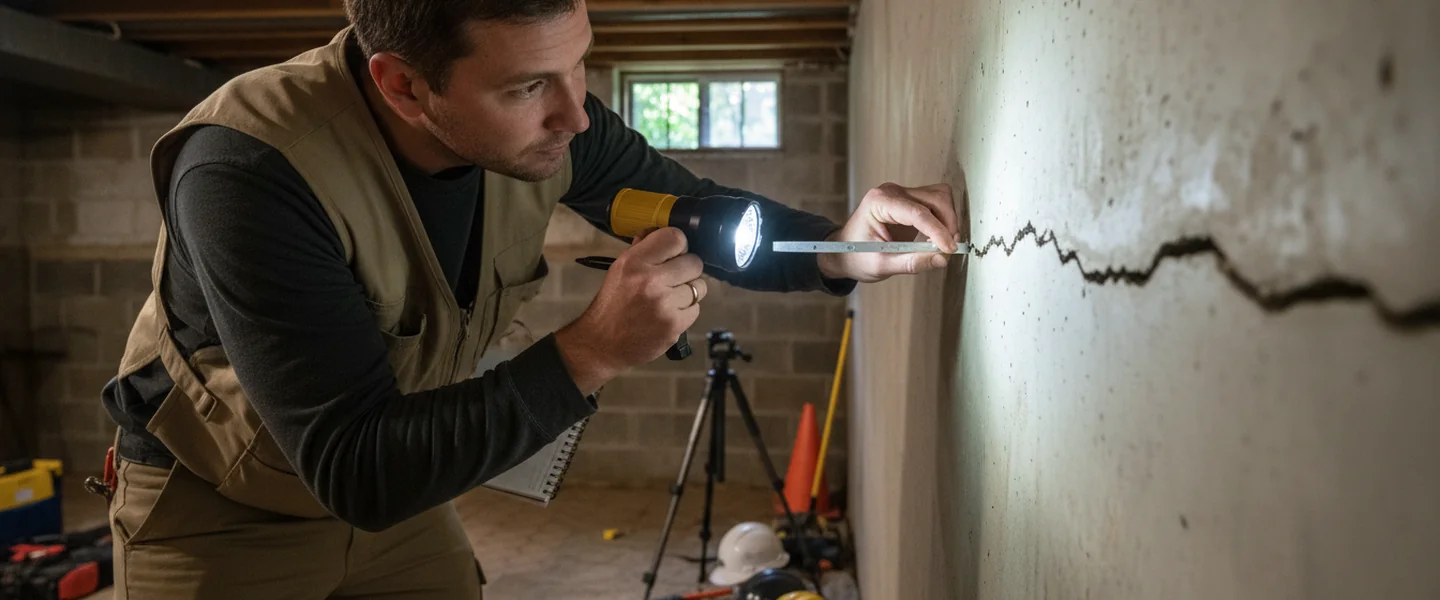
Almost every Richmond-area home develops at least one foundation crack within 30 years of construction. The question is not whether you have one — the question is whether the one you have is cosmetic, active, or structural. This guide explains the difference so you can decide whether the crack you are looking at is something you can monitor, something that needs an injection, or something that signals deeper movement.
The Three Crack Categories
1. Cosmetic / shrinkage cracks
Vertical or near-vertical, narrower than 1/16″, with no displacement (one side is not pushed past the other). These appear in the first 1-3 years of a new foundation as the concrete cures and shrinks. They do not leak under most conditions and do not signal structural movement. The fix, if any, is a thin paintable filler — not injection.
2. Active hydrophobic cracks
Vertical or diagonal, wider than 1/16″ but narrower than 1/4″, with no displacement. The signature: they wick water during heavy rain events. Polyurethane injection seals them permanently and is a low-cost, low-disruption repair. Most Richmond basement crack calls fall into this category.
3. Structural cracks
Three signals tell you a crack is structural: width over 1/4″, visible displacement (one side pushed past the other), or stair-step pattern through CMU block. Diagonal cracks above interior doorways and stair-step cracks in brick veneer are classic structural signals from differential settlement. These need a full diagnostic — not just an injection.
How to Inspect a Crack Yourself
You can do useful self-assessment in 10 minutes with a flashlight, a feeler gauge (or a coin — a nickel is roughly 1/16″), and a notepad.
- Measure width at the widest point and the narrowest. Note both.
- Check for displacement by running your finger across the crack — does one side feel pushed past the other? Lateral displacement is a structural signal.
- Check the pattern — is the crack vertical (often shrinkage), diagonal (often settlement), or stair-step through block (always settlement)?
- Check for water staining on the surrounding wall or floor. Staining means the crack has been active.
- Mark and date each end of the crack with a pencil. Re-check in 3-6 months — has it grown? Growth = active.
Why Richmond Cracks Are Different
The expansive red clay across Henrico, Chesterfield, and the western Richmond metro produces a specific crack pattern that contractors who learned the trade in sandy or loam markets often misdiagnose. The classic Richmond crack: vertical or near-vertical on the back basement wall (the high side of the graded lot), 1/16″ to 3/16″ wide, wicks water during heavy rain. The cause is hydrostatic pressure from soil saturation, not structural movement. The fix is polyurethane injection plus drainage improvement at the exterior — not piering.
The misdiagnosis costs Richmond homeowners money: a national operator’s inspector who sees the crack and quotes major piering work has either gotten the diagnosis wrong or is selling work the home does not need. A locally-owned contractor who knows the geology will quote injection for a fraction of that, plus a downspout extension to move surface water away from the foundation.
When to Call a Professional
Self-monitoring is fine for documented cosmetic cracks that are not growing. Call a foundation contractor immediately if you see any of these:
- Any crack wider than 1/4″
- Lateral or vertical displacement at the crack — one side pushed past the other
- Stair-step cracks through CMU block or brick veneer
- Diagonal cracks above interior doorways
- Cracks that have grown noticeably in 6-12 months of monitoring
- Water entry through any crack
- New cracks appearing alongside existing ones
What a Professional Inspection Should Cover
A 30-minute on-site inspection should produce: photographs of every visible crack, width and displacement measurements at each crack, crack-monitor placement at any crack flagged for monitoring, an elevation survey if differential settlement is suspected, and a written report categorizing each crack as cosmetic / active / structural. The written estimate that follows should propose repairs targeted to each category — not a single one-size-fits-all “structural stabilization” line item.
Common Repairs by Crack Type
Cosmetic crack repair
Acrylic-latex paintable filler. DIY-appropriate. No structural component. Used to prevent water staining and air infiltration, not for structural reinforcement.
Active hydrophobic crack repair
Polyurethane resin injected through surface ports. The resin expands on contact with water and seals the crack from inside the wall. Lifetime workmanship warranty appropriate. Most common Richmond-area crack repair.
Structural crack repair
Epoxy injection (re-bonds concrete) PLUS carbon-fiber straps across the crack on 4-foot centers, locked to the floor joist above. Restores wall strength. Required when the crack is wider than 1/4″ or shows displacement.
Crack-with-underlying-settlement repair
Injection of the crack PLUS underpinning at the settled corner with push piers or helical piers. This is the highest-scope repair and requires elevation survey and often engineering documentation.
Bottom Line
Not every Richmond foundation crack needs major intervention. Cosmetic cracks can be monitored and painted. Active hydrophobic cracks need polyurethane injection. Structural cracks need engineering review and a targeted repair plan. The expensive mistake is paying for piering when the actual cause is surface water management, or paying for surface paint when the underlying issue is differential settlement. Get an honest written diagnosis. Call (804) 885-2258 for a free on-site inspection.
Questions to Ask About Any Crack Repair Quote
- How did you categorize this crack (cosmetic, active, structural)? On what evidence?
- Is the underlying cause surface water, soil pressure, or settlement?
- What injection material will you use (polyurethane vs epoxy)?
- Will the repair include carbon-fiber reinforcement, and why or why not?
- What is the warranty term and is it transferable?
- Will the crack come back, and under what conditions?
What Not to Do
Three patterns that produce regret afterward:
Ignoring a crack because it is “just cosmetic.” Get a written diagnosis. A crack that looks cosmetic might be tracking displacement that you cannot see without a feeler gauge.
Painting over an active crack. Surface paint hides the visual but does not stop water entry. The next heavy rain pushes water through anyway, and now you have peeling paint plus a damp basement.
Accepting a piering quote for a crack that is actually a drainage problem. If the diagnosis is drainage, the fix is drainage — not piering. Get a second opinion before paying for the bigger repair.
Richmond-Specific Considerations
Richmond’s expansive red clay produces three predictable crack patterns we see often:
- Back-wall vertical cracks from soil saturation — almost always polyurethane injection territory, not piering
- Stair-step cracks at exterior corners from settled gutter discharge — usually piering plus a downspout extension
- Bowing-wall cracks from lateral soil pressure on un-reinforced block — carbon-fiber strapping plus injection
Knowing the pattern is what lets a local contractor diagnose your specific crack in 5 minutes instead of pushing a one-size-fits-all repair scope.
Common Misconceptions About Foundation Cracks
“Any crack means I need a major foundation repair”
False. Cosmetic shrinkage cracks are normal and require no structural repair.
“Foundation cracks are always growing”
Not always. Many cracks open during the first 1-3 years and then stabilize. Monitoring is the way to know.
“If I cannot see daylight through it, it is not serious”
False. Internal displacement and lateral movement can produce serious cracks that look minor from the surface.
“Sealing the crack from inside means it is permanent”
Polyurethane injection IS permanent if the underlying cause is hydrostatic pressure. If the underlying cause is ongoing settlement, the wall will crack again somewhere else — and that is a separate condition needing piering, not a failure of the injection.
Get a Free Written Foundation Quote in 24 Hours
Same-week appointments. No high-pressure sales. Every quote itemized in writing after a 30-minute on-site inspection.