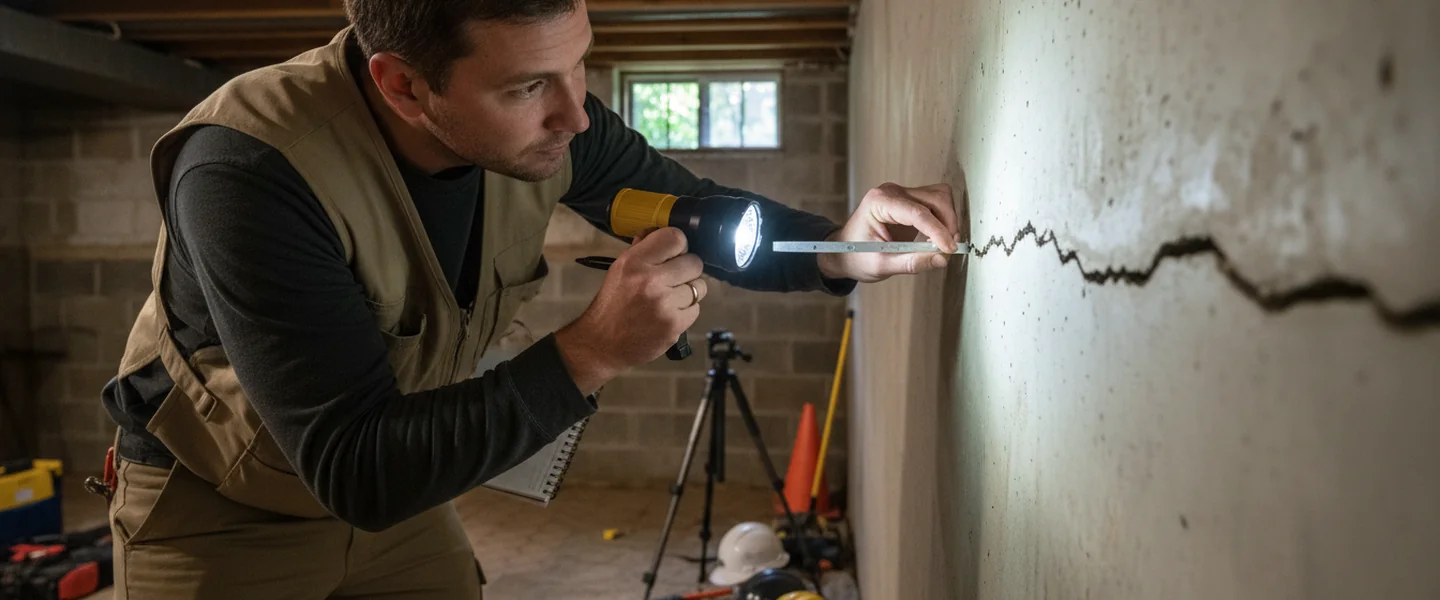
If you are searching “foundation repair cost Richmond VA” you are probably staring at a wet basement wall, a stair-step crack in your brick veneer, or a quote that came in higher than you expected. This guide is not a price list — Richmond foundation work is not commodity-priced and any contractor who quotes it sight-unseen is gambling with your repair. Instead, here are the actual scope factors that drive cost, what a written quote should contain line-by-line, and how to compare two estimates for the same job.
Why There Is No Honest “Average Cost” for Richmond Foundation Repair
National home-improvement aggregator sites will quote a sprawling “average” foundation repair range that spans from a single low-cost injection to a full multi-pier underpinning. That range is technically accurate and operationally useless. A single polyurethane crack injection sits at one end; a 12-pier underpinning with engineering, permit coordination, and finish work coordination sits at the other. Knowing the average tells you nothing about your specific situation.
What an honest contractor can do is name the factors that drive Richmond-area cost. We list them below — every one of them shows up on our written estimates.
What Drives the Cost of Your Specific Project
1. Scope of work
This is the largest single factor. Are we sealing one crack or twelve? Driving four push piers or fourteen? Installing a sump pump alone, or a full perimeter French drain with sump and battery backup? Scope drives everything else.
2. Foundation type and access
Poured concrete walls accept injection cleanly. CMU block walls require slightly different injection technique and sometimes additional surface ports. Stone foundations — common in older Bon Air and Tuckahoe homes — require yet another approach. Crawlspace access vs full basement access affects labor hours.
3. Soil profile and depth to bearing strata
For piering work, the depth to competent bearing strata determines the number of pier sections required at each location. In Richmond’s Piedmont-to-Coastal-Plain transition, depth varies block-by-block. A pier at a Glen Allen home might hit refusal at 18 feet; the same pier at a Chesterfield home a mile away might need 28 feet.
4. Engineering documentation
Some projects require a Virginia-licensed structural engineer to issue stamped repair drawings. Those engineering letters are a separate line item, and the engineer’s fee is disclosed in writing before they are scheduled. Projects under 4 piers and minor crack repair typically do not require an engineer.
5. Permit cost
Henrico, Chesterfield, Hanover, and the City of Richmond each have their own permit fees and processes. We pull permits in our name and pass through the actual permit cost — no markup.
6. Site access and disruption
Can we drive equipment to the work area, or does it have to be hand-carried? Is there mature landscaping that requires careful work-around? Is the basement finished, requiring drywall and trim coordination? All affect labor hours.
7. Materials brand and grade
We install ECP steel push piers, Fortress Stabilization carbon fiber, Zoeller and Pro Series sump pumps, and Stego-grade vapor barriers. Off-brand alternatives exist at lower cost and lower durability. We do not install them.
8. Warranty terms
Transferable lifetime workmanship warranties on the install plus manufacturer warranties on pier hardware are part of the cost. Operators who offer only year-long workmanship warranties price lower up front — that is a meaningful comparison point when you read two quotes.
Anatomy of a Written Foundation Repair Quote (What You Should See)
A properly written Richmond-area foundation quote contains every one of these line items:
- Scope description in plain English (not “structural reinforcement” — specifics)
- Materials list with brand names
- Labor hours and crew size
- Permit responsibility and pass-through cost
- Engineering documentation cost if applicable, with engineer named
- Drying and cure times
- Warranty terms (years, transferability, what’s covered, what’s NOT covered)
- Payment schedule (typically 30% at start, 30% at midpoint, 40% at completion)
- Start date estimate
- Total dollar amount with no hidden line items
If your existing quote is missing any of these, ask for them in writing before signing.
Richmond-Specific Cost Considerations
Two factors make Richmond-area foundation work somewhat more involved than the national average, and both show up in the written estimate.
Expansive clay. Push piers in central Virginia expansive clay frequently need 2-3 additional pier sections per location compared to sandy or loam markets, because refusal pressure develops at a deeper bearing strata. That adds material and time per pier location.
Permit-and-inspection cadence. Henrico and Chesterfield County permit offices have a 3-5 business day turnaround on foundation work permits, which we factor into our start-date estimate. The City of Richmond can be slightly faster but inspection scheduling is less predictable.
How to Compare Two Foundation Quotes (Without a PE Degree)
Side-by-side quote comparison is where most homeowners get into trouble. National franchise operators quote in vague generalities (“structural stabilization system”), which makes their bid look comparable to a detailed local quote that names materials, depths, and pier counts. They are not the same scope.
Five questions to ask both contractors:
- How many piers, exactly, and to what depth? A vague “we will install piers as needed” is not a real scope.
- What is the manufacturer of the piers? ECP, AB Chance, Earth Contact Products, Atlas — all are reputable. A bid that does not name the manufacturer is hiding something.
- Is engineering documentation included? For 4+ pier jobs, the answer should be yes.
- What is the warranty term, and is it transferable? “Lifetime” is meaningless if it is not in writing and not transferable.
- Who pulls the permit, and who pays the permit fee? The right answer is: contractor pulls it in their name, homeowner pays the actual permit cost as a pass-through line item.
Bottom Line
Foundation repair in Richmond is not a commodity. The right cost for your specific project is determined by scope, soil, materials, warranty, and the experience of the crew doing the install — not by a phone-quoted number from a franchise dispatcher. Get the inspection in writing, compare written quotes line-by-line, and ask the five questions above. Call (804) 885-2258 for a free on-site inspection and written estimate.
Questions to Ask Any Richmond Foundation Contractor
- How long have you been doing foundation work in the Richmond metro specifically?
- Will the same crew on the inspection be on the install, or do you subcontract?
- What is your written warranty term, and is it transferable to a buyer if I sell?
- Do you pull permits in your name?
- What manufacturer of pier hardware (or carbon fiber, or pump) do you install?
- Will you provide a written second-opinion review of another contractor’s existing quote?
What Not to Do
Three patterns that consistently cost Richmond homeowners money:
Accepting a phone-quoted price. Foundation work cannot be honestly quoted over the phone. The number you hear on the call is a sales hook; the real number arrives after the on-site visit and is typically higher.
Signing a contract at the inspection visit. Reputable contractors deliver written estimates by email within 24 hours. If a sales rep refuses to leave without a signature, that is a red flag — walk them to the door.
Choosing the lowest bid without comparing scope. The cheap bid usually omits permits, engineering, transferable warranty, or specifies cheaper hardware. Read the line items before deciding.
Common Misconceptions About Foundation Repair Cost
“All foundation contractors charge about the same”
They do not. National franchise operators routinely quote 1.5-2x what a comparable locally-owned contractor charges for identical scope, because they price in a national sales overhead that locals do not carry.
“The cheap quote is the same work as the expensive quote”
Sometimes, but usually not. The cheap quote often omits permits, engineering, transferable warranty, or specifies thinner-gauge hardware. Read both written estimates line-by-line before deciding.
“Foundation repair is always covered by homeowners insurance”
Almost never, in Virginia. Standard policies exclude movement from settlement, expansive soil, and gradual water damage. Exceptions exist (burst plumbing under the slab, sudden sinkhole) but they are exceptions, not the rule.
“My uncle’s repair in 1985 cost $X so mine should be similar”
Materials and labor have changed substantially since 1985. Modern push-pier systems, carbon fiber, and code-compliant sump systems perform better and cost more in real dollars. The “uncle’s repair” reference is not a useful pricing anchor.
Get a Free Written Foundation Quote in 24 Hours
Same-week appointments. No high-pressure sales. Every quote itemized in writing after a 30-minute on-site inspection.